
How to use ChatGPT as a doctor
Doctors are increasingly turning to ChatGPT and generative AI tools to improve efficiency and reduce documentation time.



Popular articles
How Doctors Can Use ChatGPT and AI Tools in Clinical Practice
Doctors are increasingly turning to ChatGPT and generative AI tools to improve efficiency and reduce documentation time.
What is ChatGPT?
ChatGPT is an artificial intelligence chatbot that utilizes natural language processing to generate responses that mimic human conversation. It can answer questions, explain concepts, summarize information, and write text in many different styles. OpenAI created ChatGPT and first released it in 2022.
The name "GPT" stands for Generative Pretrained Transformer:
- Generative:
It generates new text, including explanations, summaries, draft letters, and responses to conversations. - Pre-trained:
The model was trained on a tremendous amount of text before it became available to users. This training allows ChatGPT to understand language structure and provide informed responses. - Transformer:
"Transformer" refers to a deep-learning architecture that enables tools like ChatGPT to understand language context and generate fluent text. The transformer model processes all parts of a sentence simultaneously and uses self-attention mechanisms to determine which words are most relevant, enabling coherent and context-aware replies.
In simple terms, ChatGPT is a tool that produces helpful text based on what you ask. It can feel like interacting with a knowledgeable assistant who responds instantly.
Many other AI chatbots are available, including Google Gemini and Microsoft Copilot. Each uses large language models to perform similar tasks, although the technology behind them varies.
For more background on how AI affects physician workflows, see Ambient AI scribes: Lessons from 2.5 Million Patient Encounters
How Physicians Should Approach ChatGPT
Before using AI tools in a medical setting, keep these best practices in mind:
- Before using AI tools in a medical setting, consider the following best practices. Always verify medical information using trusted clinical resources.
- Never enter protected health information into a chatbot to maintain HIPAA-compliance.
- If you use AI to help write any text, note that it provides assistance in the chart.
- Consult legal or compliance experts if you have questions about responsible AI use.
To learn more about reducing administrative burden, see Beyond Dictation: Emerging Trends in Physician Documentation.
Five Useful Ways Doctors Can Use ChatGPT
1. Simulate Medical Consults
Physicians can use ChatGPT to explore differential diagnoses, guideline summaries, and clinical questions. It works well for brainstorming and organizing thoughts, especially when dealing with complex cases.
Examples include:
- "List possible causes of acute vertigo in adults."
- "What labs should I consider when evaluating new onset anemia?"
- "Summarize the diagnostic criteria for Sjogren syndrome."
ChatGPT should not replace clinical judgment, but it can support quick thinking and help clinicians double-check that they did not miss important considerations.
For more support with documentation organization, see How to Write Clinical Notes Faster.
2. Check Drug Interaction Information
Although dedicated drug interaction systems remain the standard, some physicians use ChatGPT as a secondary, quick check. You can provide a medication list and request information on potential interactions, side effects, or contraindications.
Always confirm results with trusted clinical systems or references.
3. Practice Sensitive Patient Conversations
ChatGPT is helpful for rehearsing difficult conversations. Physicians can ask the AI to describe common emotions, concerns, or patient questions related to:
- cancer diagnoses
- chronic pain
- mental health conditions
- eating disorders
- end-of-life planning
Utilizing AI to explore patient perspectives can enable clinicians to communicate with greater clarity, compassion, and confidence.
4. Improve Written Communication
Physicians spend a significant amount of time drafting clinical and administrative text. ChatGPT can help draft:
- after visit summaries
- referral letters
- patient education materials
- letters of medical necessity
- insurance appeals
- email responses
- policy summaries
These drafts can reduce administrative workload and save valuable time that would otherwise be spent typing.
To improve efficiency even further, see Typing vs. Dictation- Which is Faster?
5. Automate note-taking with an AI medical scribe
Two years after the launch of ChatGPT, numerous software solutions are now available that package ChatGPT's underlying technology for specific professional use cases. AI medical scribes are a powerful new category of tools that utilize generative artificial intelligence to facilitate scribe-like capabilities in real-time.
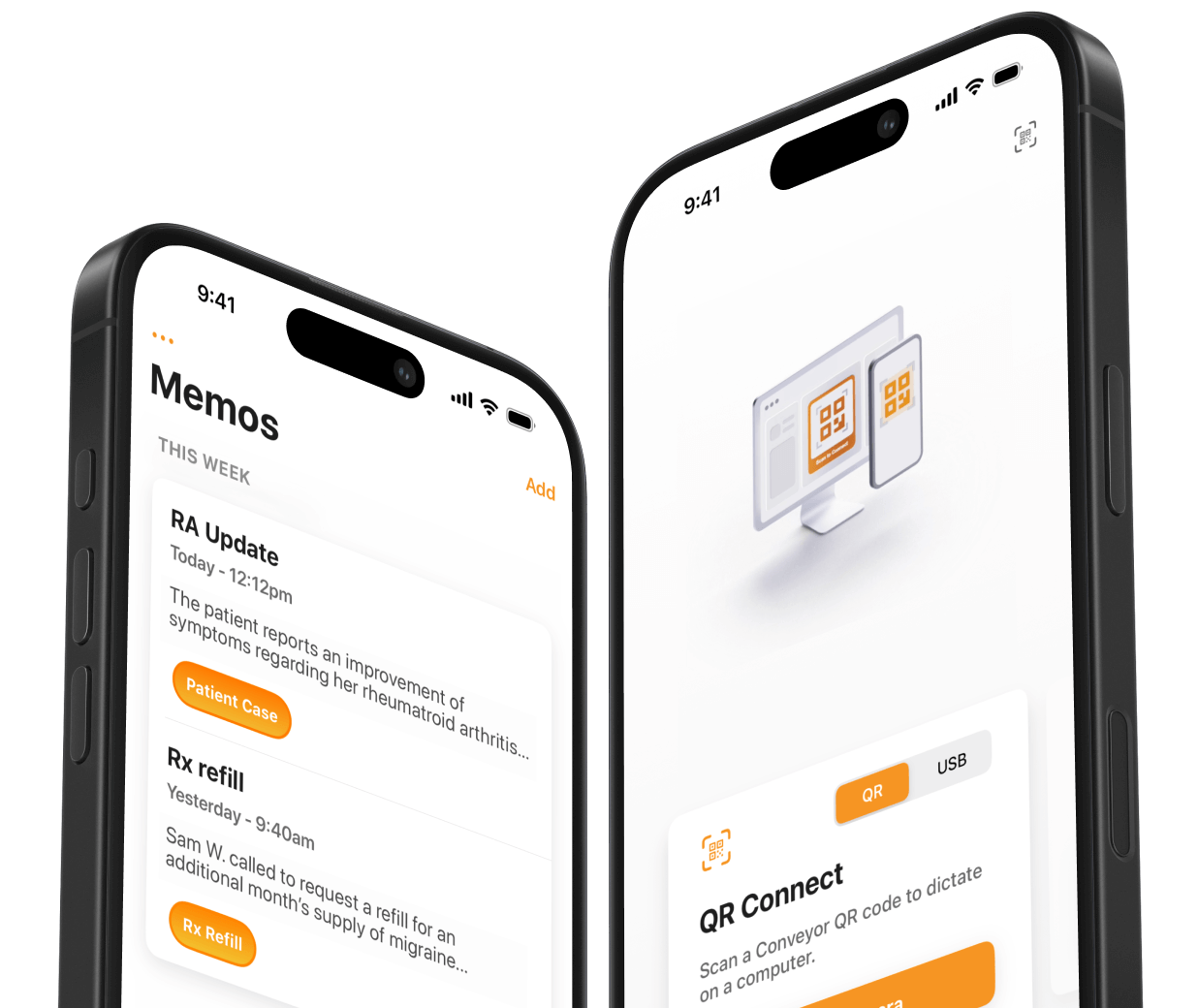
One example is Mobius MD's Conveyor AI, a leading smartphone-based, specialized medical scribe that works with any EMR on any Mac or Windows computer. Conveyor AI listens to any clinician-patient interaction and generates a comprehensive clinical note in under 60 seconds.
To learn more about how ambient AI scribe systems work, see How Ambient AI Scribe Technology Is Revolutionizing Medical Documentation.
Why Doctors Should Consider Using AI Tools Now
Artificial intelligence is already reshaping clinical communication, documentation, and administrative workflows. Healthcare organizations are rapidly adopting AI tools, and physicians who gain early familiarity will be better prepared as these systems become more deeply integrated into the care delivery process.
For physicians seeking to reduce charting time and enhance workflow efficiency, exploring AI tools is a significant step forward.
To learn how physicians reduce charting time with mobile dictation and AI scribing, explore Conveyor AI, an ambient medical scribe designed for real clinical workflows.
FAQ: How Physicians Can Use ChatGPT and AI Tools
Is ChatGPT safe for medical use?
ChatGPT can support clinical thinking, but it should not be used as a primary medical source. Physicians should verify all medical information through trusted sources and avoid entering any protected health information into chatbots.
Can doctors use ChatGPT to help with clinical documentation?
Yes, many physicians use ChatGPT to draft summaries, letters, and educational materials. Any AI-generated text should be reviewed and edited, and physicians should document the use of AI assistance when applicable.
How does an AI medical scribe work?
AI medical scribes use generative AI to listen to the physician-patient encounter and create a structured clinical note. They are specially-trained and optimized for medical accuracy and correctness. Tools such as Conveyor AI can produce a comprehensive note in seconds, allowing providers to spend more time with patients and less time typing.
What are the limitations of ChatGPT in healthcare?
ChatGPT cannot confirm diagnoses, interpret diagnostic results, or integrate directly with EHR systems. It may also produce inaccurate or outdated information, making physician oversight essential.
Can AI tools help reduce the time spent on documentation?
Yes. AI tools can reduce administrative burden by assisting with writing tasks, summarizing information, and generating encounter notes through ambient listening. Many clinicians report significant time savings when combining dictation tools with AI scribe technology.
Related Articles
.png)





Contact us
We proudly offer enterprise-ready solutions for large clinical practices and hospitals.
Whether you’re looking for a universal dictation platform or want to improve the documentation efficiency of your workforce, we’re here to help.