
DAX Copilot vs. Conveyor AI: Choosing The Right AI Medical Scribe
Compare Dragon Copilot and Conveyor AI to see how different AI scribe architectures support documentation workflows across organizations of all sizes.


Popular articles
Dragon Copilot and Conveyor AI are two leading AI medical scribe platforms designed to streamline clinical documentation and reduce provider burnout. Used by healthcare organizations of all sizes, these AI scribes help convert patient encounters into structured clinical notes supporting various deployment models, workflows, and integration strategies. This comparison examines how Dragon Copilot and Conveyor AI differ in architecture, flexibility, and implementation to help organizations choose the right documentation approach.
Dragon Copilot (DAX): Enterprise-Oriented AI Documentation
Dragon Copilot, developed by Nuance (now part of Microsoft), is an AI medical scribe designed to support large-scale clinical documentation workflows, particularly within health systems and organizations that prioritize native EHR integration and centralized deployment.
Key strengths of Dragon Copilot:
Deep EHR integration
Dragon Copilot integrates directly with supported EHR platforms and is commonly deployed as part of an organization-wide documentation strategy.
Enterprise scalability
The platform is built to support large volumes of users across departments and specialties within complex clinical environments.
Advanced analytics and reporting
Health systems can analyze documentation time savings, utilization patterns, and operational impact at scale.
Considerations
- Requires IT involvement and EHR configuration
- Availability depends on EHR compatibility
- Often bundled with Dragon Medical One
- Typically licensed through enterprise agreements
- Best suited for standardized, centrally managed documentation workflows
Dragon Copilot is often a strong fit when documentation strategy emphasizes tight EHR integration, system-wide consistency, and IT-managed deployment.
Conveyor AI: EMR-Independent, Mobile-First Documentation
Conveyor AI takes a fundamentally different approach. Instead of integrating deeply with the EHR, Conveyor AI operates independently of the EMR, allowing clinicians to document seamlessly in any EMR.
Why clinicians choose Conveyor AI
1. Works with any EMR
Conveyor AI does not require APIs, plug-ins, or EHR-specific builds. It functions like an external input device, allowing clinicians to:
- Dictate or generate AI notes into any EMR
- Use Microsoft Word, Google Docs, Apple Pages, or any text editor
- Document during telehealth, inpatient, or home workflows
This EMR-agnostic design eliminates IT bottlenecks and deployment delays.
2. Dictation + AI Scribe in one app
Many clinicians using Nuance products rely on:
- Dragon Medical One for dictation
- Dragon Copilot (DAX) for ambient notes
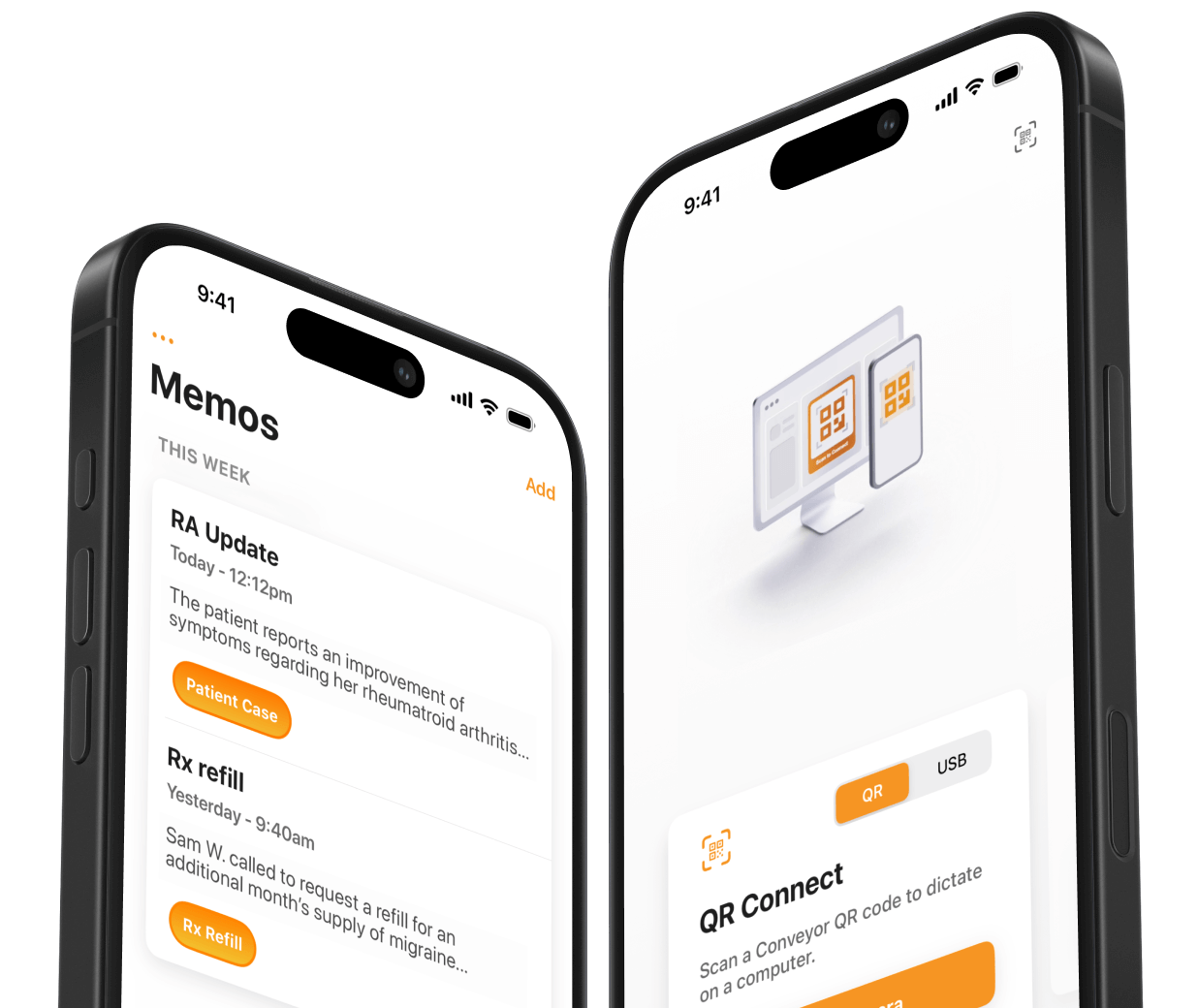
Conveyor AI combines medical dictation and AI scribing in a single, mobile app, reducing the need for tool switching, logins, and subscription complexity.
3. True Mobile Workflow
Conveyor AI is built around the clinician's smartphone:
- Works on iPhone and iPad
- Connects instantly to Mac or Windows computers
- No workstation installation
- No admin privileges required
Clinicians can document from exam rooms, hospital floors, home offices, or telehealth sessions without changing workflows.
4. Faster Setup, Less IT Dependency
Because Conveyor AI does not integrate directly with the EHR:
- No IT tickets
- No workstation licensing
- No virtual desktop configuration
- No EHR downtime dependency
This makes Conveyor AI particularly attractive to:
- Independent providers
- Small to mid-size practices
- Multi-location groups
- Mixed Mac & PC environments
Which AI Medical Scribe Is Right for You?
Choose Dragon Copilot if:
- You require native EHR integration at the system level
- Documentation tooling is standardized across departments
- IT-managed deployment is preferred
Choose Conveyor AI if:
- You want rapid deployment with minimal IT overhead
- You support mixed environments (Mac, Windows, telehealth, mobile)
- You want both dictation and AI scribing in one platform
- You value flexibility alongside existing enterprise systems
Why EMR-Independent AI Scribes Matter
Healthcare technology has advanced rapidly; however, the complexity of EHRs remains a significant source of clinician frustration. EMR-independent tools like Conveyor AI give providers control over their documentation workflow, regardless of vendor, setting, or device.
By reducing administrative burden and allowing clinicians to focus on patient care, modern AI scribes directly support:
- Provider wellbeing
- Patient experience
- Operational efficiency
The best AI medical scribe isn't just the most powerful. It's the one that fits seamlessly into how clinicians actually work.
Final Thoughts
Both Conveyor AI and Dragon Copilot are capable, modern documentation tools. The key difference lies in who controls the workflow: the institution or the clinician.
Conveyor AI offers a flexible, mobile-first, EMR-independent alternative that continues to gain adoption among providers who want speed, simplicity, and freedom from IT constraints.
Frequently Asked Questions
What is an AI medical scribe?
An AI medical scribe helps convert patient encounters into structured clinical documentation using speech recognition and artificial intelligence.
Do AI scribes require direct EHR integration?
Not always. Some AI scribes integrate directly with the EHR, while others operate independently, allowing clinicians to document in any application of their choice.
How do AI scribes impact clinician burnout?
Studies show that AI scribes can reduce documentation time and cognitive load, allowing clinicians to spend more time with patients and less time on administrative tasks. The impact depends on how well the tool aligns with existing workflows.
Related Articles





Contact us
We proudly offer enterprise-ready solutions for large clinical practices and hospitals.
Whether you’re looking for a universal dictation platform or want to improve the documentation efficiency of your workforce, we’re here to help.