
The Quadruple Aim of Healthcare: Improving Patient Care by Supporting Provider Wellbeing
The Quadruple Aim builds on healthcare's Triple Aim by adding provider wellbeing as essential for success. Without thriving care teams, patient outcomes suffer.


Popular articles
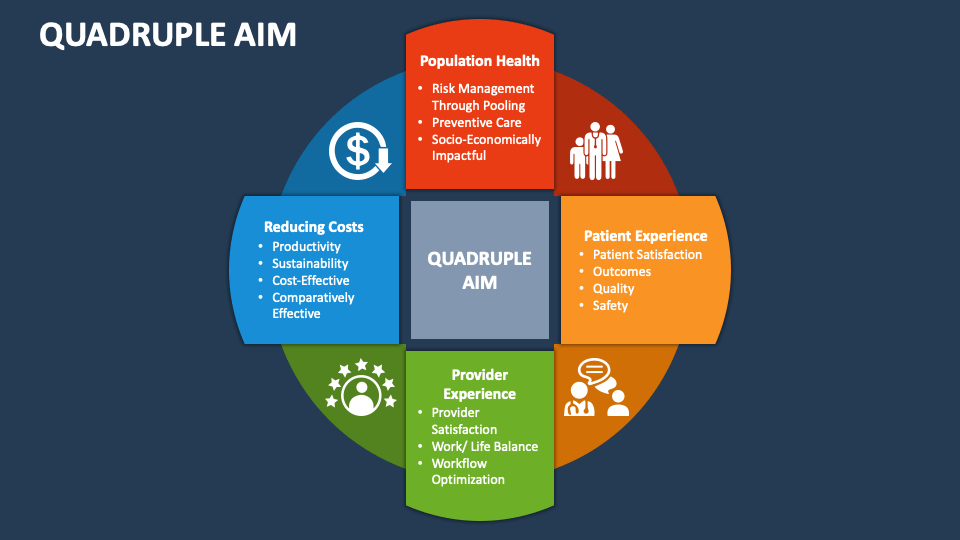
The Triple Aim of healthcare refers to three core goals: enhancing the patient experience, improving population health, and reducing per capita healthcare costs. While these goals remain essential, healthcare leaders have increasingly recognized that the Triple Aim cannot be fully achieved unless clinicians and care teams are supported and able to thrive in their work environments.
This realization led to the development of the Quadruple Aim of healthcare, a more holistic framework for health system improvement that adds a critical fourth goal focused on enhancing provider wellbeing.
Today, the Quadruple Aim is widely used by healthcare organizations, policymakers, and clinical leaders as a guiding framework for delivering sustainable, high-quality care.
What Is the Quadruple Aim of Healthcare?
The Quadruple Aim of healthcare builds on the original Triple Aim by recognizing that high-quality care, effective cost control, improved population health, and enhanced patient experience all depend on the well-being of the healthcare workforce, a relationship highlighted by the National Academy of Medicine’s work on clinician burnout and professional well-being.
The four components of the Quadruple Aim are:
- Enhancing the patient experience
- Improving population health
- Reducing the per capita cost of healthcare
- Enhancing provider wellbeing
Together, these four aims promote a healthcare system that delivers better outcomes while also supporting the clinicians and care teams who provide that care.
1. Enhancing the Patient Experience
At its core, the Quadruple Aim focuses on improving patients' lives. Enhancing the patient experience includes:
- Improving healthcare access and equity
- Strengthening communication between patients and care teams
- Increasing safety, satisfaction, and clinical outcomes
When clinicians have the time, support, and tools to focus on patient care rather than administrative tasks, patient trust, engagement, and outcomes improve.
2. Improving Population Health
The original Triple Aim introduced population health as a central focus, shifting attention beyond individual patient encounters to the health outcomes of entire communities.
Healthcare organizations now address broader social determinants of health, including housing stability, education, transportation, and nutrition. By partnering with community organizations, health systems can support prevention, early intervention, and long-term disease management, ultimately improving outcomes across populations.
3. Reducing the Per Capita Cost of Healthcare
Rising healthcare costs continue to be a major challenge. The Quadruple Aim emphasizes the importance of financial sustainability through:
- Value-based care models
- Improved care coordination
- Preventive and proactive treatment strategies
By reducing inefficiencies and administrative waste, healthcare organizations can reinvest resources into patient care and workforce support.
4. Enhancing Provider Wellbeing
The defining addition of the Quadruple Aim is its focus on provider wellbeing, often described as "joy in work" or improving the clinician experience.
In 2019, physician burnout was formally recognized as a public health crisis, and recent data show that roughly 45% of physicians reported at least one symptom of burnout in 2024, illustrating that the problem persists even as some rates decline.
Burnout has been linked to increased medical errors, lower patient satisfaction, reduced care quality, and higher healthcare costs. To understand the extent to which this issue remains widespread and persistent, refer to the state of physician burnout for the latest trends and insights into clinician well-being and workplace stress.
While many clinicians have worked to improve work-life balance individually, meaningful and lasting change requires organizational solutions that reduce administrative burden and support mental health across the entire care team.
Who Coined the Term "Quadruple Aim"?
The concept of the Quadruple Aim was introduced in 2014 by Dr. Thomas Bodenheimer and Dr. Christine Sinsky.
Their work expanded upon the Triple Aim framework originally developed and promoted by the Institute for Healthcare Improvement (IHI). In their article, Bodenheimer and Sinsky emphasized that clinician burnout undermines patient-centered care, outcomes, and cost control, stating:
"Burnout among the health care workforce threatens patient-centeredness and the Triple Aim."
In short, there is no Triple Aim without addressing provider wellbeing.
How Can Healthcare Systems Support Provider Wellbeing?
Healthcare organizations can support the Quadruple Aim by implementing strategies that improve efficiency, reduce burnout, and allow clinicians to focus more of their time and energy on patient care, including the use of ambient AI scribe technology to reduce documentation burden.
Key strategies include:
- Team-based documentation, enabling nurses, medical assistants, and support staff to assist with EHR documentation, order entry, prescription processing, and charge capture
- Pre-visit planning and pre-appointment lab testing to reduce time spent reviewing follow-up results
- Expanded team roles, allowing staff to manage preventive care and chronic disease coaching under physician-approved standing orders
- Co-located care teams, which research shows can improve communication, collaboration, and efficiency
Training and support, ensuring staff who take on new responsibilities are set up for success
The Role of Technology in the Quadruple Aim
Since the Quadruple Aim was introduced, healthcare technology has advanced significantly. EHRs have become standard tools, and AI-driven clinical documentation is transforming the way care teams work.
Technologies such as medical speech-to-text dictation and AI medical scribes help reduce documentation burden, improve note quality, and allow clinicians to spend more time with patients – and less time charting after hours.
When thoughtfully implemented, these tools directly support the Quadruple Aim by improving efficiency, reducing burnout, and enhancing both patient and provider experiences.
Why the Quadruple Aim of Healthcare Matters Today
The Quadruple Aim reflects a fundamental truth of modern healthcare: high-quality, cost-effective care depends on healthy, supported clinicians.
By prioritizing provider wellbeing alongside patient experience, population health, and cost control, healthcare organizations can build more resilient systems that deliver better outcomes for everyone involved.
Related Articles






Contact us
We proudly offer enterprise-ready solutions for large clinical practices and hospitals.
Whether you’re looking for a universal dictation platform or want to improve the documentation efficiency of your workforce, we’re here to help.