
9 Best AI Medical Scribe Companies to Try in 2026
Compare the best AI medical scribe companies to try in 2026: features, pricing & EMR integrations. See how Conveyor AI stacks up against other AI solutions.



Popular articles
If you’ve searched for the best AI apps in healthcare lately, you’ve probably noticed that AI medical scribes have moved from “nice-to-have” to “must-have.” Recent reports show clinicians now spend around 13.5 hours per week on clinical documentation, with several hours of that happening outside normal working hours — the dreaded “pajama time.”
At the same time, investment in AI clinical documentation has surged, with new startups and enterprise platforms racing to reduce documentation burden and physician burnout.
This guide compares nine leading AI medical scribe companies, focusing on:
- Note quality and accuracy
- Ease of use and workflow fit
- EHR integration strategy
- Security and compliance
- Pricing and scalability
We’ll keep things neutral and fact-based — and we’ll also explain why, for many clinics, Mobius MD’s Conveyor AI often ends up at the top of the shortlist.
How We Evaluated AI Medical Scribe Companies
To make this comparison useful for real clinic days (not just a feature checklist), we focused on:
- Note quality & accuracy
Can the tool reliably turn conversations into chart-ready notes with minimal editing? Many leading tools now generate full SOAP notes or progress notes in under a minute. - Ease of use & adoption
Setup time (minutes vs. months), device flexibility (mobile, desktop, browser), and how well the tool fits existing workflows, including telehealth and multi-site work. - EHR compatibility
Some vendors offer deep, direct Epic or Cerner integrations; others (like Mobius MD) emphasize “works with any EMR” using secure text streaming across Mac and Windows. - Security & compliance
HIPAA/HITECH alignment, encryption, data storage policies, and where PHI is processed. - Pricing & scalability
Self-serve subscriptions vs. enterprise contracts, plus how easily you can scale from one clinician to many. - Support, training & updates
Access to real humans, robust documentation, and a visible product roadmap that keeps up with AI advances.
With that in mind, let’s break down the leading AI medical scribe companies used in 2025.
Top AI Medical Scribe Companies To Use in 2026
1. Mobius MD (Conveyor AI) — best overall for flexible, EMR-agnostic workflows
Best for: Practices that want a mobile-first AI scribe and dictation platform that works with every EMR across Mac and Windows.
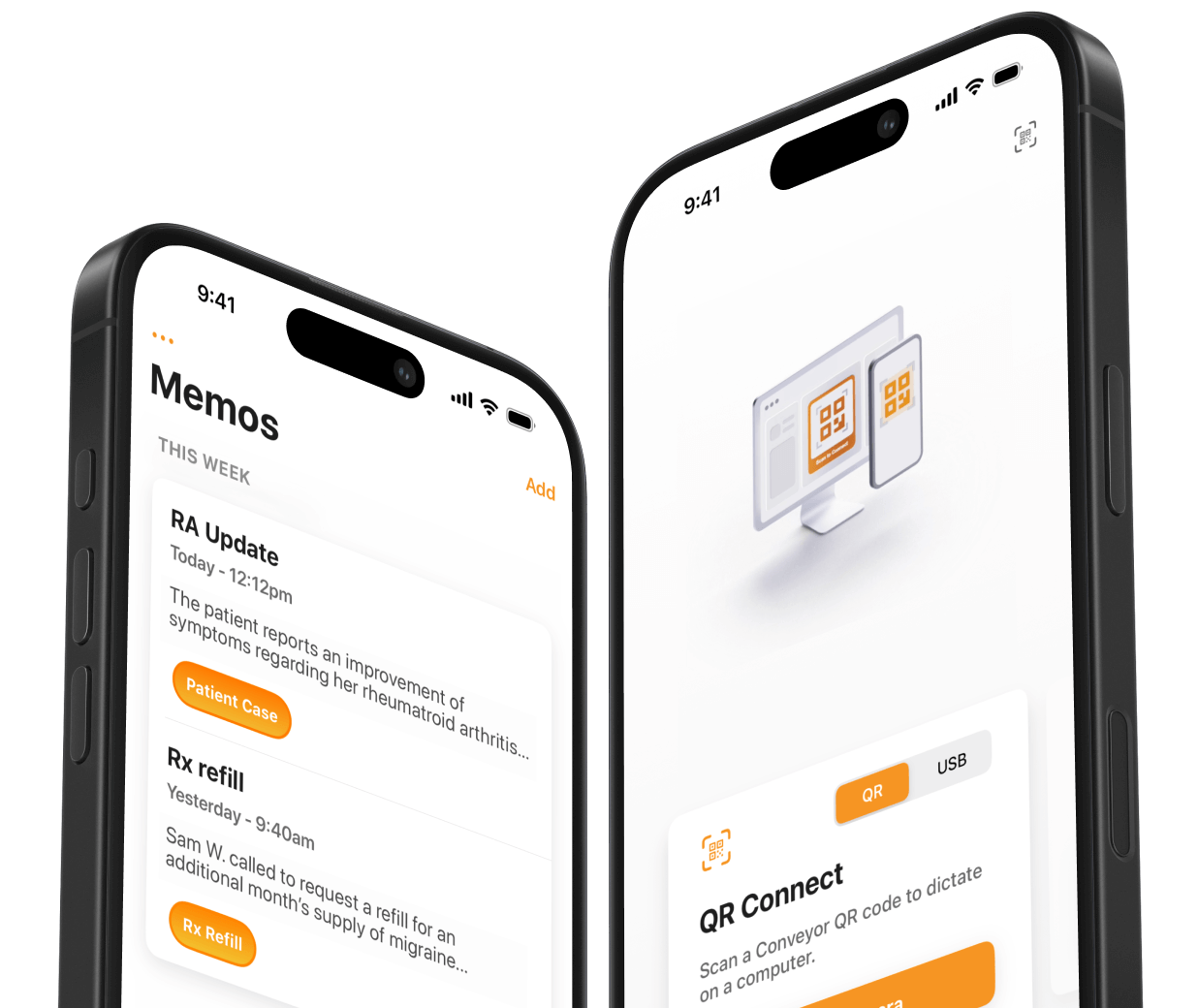
Mobius MD's Conveyor AI is a clinician-focused documentation platform which combines AI medical scribing with industry-leading medical dictation.
Conveyor AI listens to the clinician–patient encounter and automatically completes around 80% of the EMR note in roughly a minute, so you can review, tweak, and sign instead of writing from scratch.
Instead of locking you into one EHR, Mobius streams text from your iOS device securely to any Mac or Windows computer, placing text wherever the cursor sits. That means it works with essentially any EMR you already use.
Mobius also offers:
- High-accuracy medical dictation into any field, not just notes
- Customizable templates and memos for fast reuse
- A decade of experience building mobile tools like Mobius Clinic for athenahealth users.
From a pricing standpoint, Mobius Conveyor dictation typically runs around $149 per month for unlimited, premium medical speech-to-text, with AI scribe and enterprise options layered on top depending on practice size.
Why does it often come out on top
- Universal EMR compatibility (huge for groups using multiple systems or changing jobs)
- Fast, accurate notes with AI doing the bulk of the work
- Mobile-first design that fits how clinicians actually move through their day
- Transparent, documentation-focused philosophy — Mobius’ blog extensively covers how ambient AI scribes work, their limitations, and how to keep clinicians in full control of the chart.
2. Freed — AI scribe for small and midsize ambulatory clinics
Best for: Small and midsize clinics (roughly 2–50 clinicians) that want a straightforward AI scribe with quick setup and strong support.
Freed focuses on SOAP-style notes and ease of onboarding. It captures the visit, generates structured notes, and lets you push documentation directly into many browser-based EHRs with one click.
Pricing is in the ~$90/month per clinician range for individuals on annual plans, with group discounts and a 7-day full-access trial.
Freed is less about dictation and more about an ambient scribe that adapts to your style, which makes it competitive for clinics that want structured notes without the complexity of enterprise IT projects.
3. Nuance DAX Copilot — ambient scribe for Epic-led hospital systems
Best for: Large health systems running Epic or Meditech that want deeply embedded ambient documentation.
Nuance DAX Copilot, part of Microsoft’s Nuance portfolio, is one of the most established enterprise AI scribes. It integrates tightly with Epic and other major EHRs, automatically documents encounters, and routes finished notes into the chart.
DAX Copilot is designed for system-wide deployments with robust analytics, governance, and IT controls. Public estimates place pricing at roughly $600+ per clinician per month, making it a premium option suited for hospital budgets rather than solo practices.
4. Abridge — LLM-driven notes for Epic enterprises
Best for: Epic-based enterprises that want generative AI documentation.
Abridge converts clinician–patient conversations into structured notes with LLM-enhanced summaries, tightly integrated into Epic.
Its “Linked Evidence” feature maps parts of the note back to audio segments, helping clinicians quickly verify the AI’s output. Abridge primarily sells to large systems, with typical pricing around $2,500 per clinician per year (~$200+/mo) according to investor and industry reports.
5. Suki — documentation plus coding and workflow automation
Best for: Large, multi-specialty groups looking for an AI assistant that goes beyond notes.
Suki is marketed as an ambient clinical intelligence platform. Alongside AI notes, it offers:
- Voice commands for orders and referrals
- Coding assistance
- Integrations with Epic, athenahealth, Meditech, Cerner, and more.
Industry analyses suggest Suki runs roughly $300–$400 per user per month, with additional costs for customization and training — again pointing it at IT-supported organizations rather than small clinics.
6. DeepScribe — ambient scribe for specialty-heavy organizations
Best for: Oncology, cardiology, and specialty groups that want EHR-integrated notes and coding prompts.
DeepScribe provides ambient capture and writes notes directly back into EHRs such as athenahealth, eClinicalWorks, Epic, and AdvancedMD. It’s known for embedding E&M coding suggestions into draft notes, supporting compliance and reimbursement.
DeepScribe follows an enterprise pricing model with custom quotes; independent comparisons often place it in the higher price tier among AI medical scribe companies.
7. Heidi Health — global AI scribe with a freemium model
Best for: Clinics in Australia, the UK, Canada, and beyond that want a freemium, globally oriented AI scribe.
Australian-founded Heidi Health positions itself as an “AI care partner”. It provides:
- Ambient note generation
- Automated letters and follow-ups
- Template-driven workflows
- Growing support for over 100 languages
Heidi offers a free core AI scribe and paid tiers (often in the $70–$99/month range) with more personalized templates and features.
8. Nabla — multilingual ambient assistant for digital health
Best for: Digital-first health organizations and larger systems needing multilingual support.
Nabla Copilot listens to consultations, generates structured notes, and supports multiple languages, with providers reporting sub-20-second note generation in many workflows.
Nabla offers a free tier and paid plans starting around $119 per user per month, making it an interesting bridge between lightweight tools and full enterprise platforms.
9. Tali — hybrid dictation, ambient scribe, and medical search
Best for: Clinicians and small teams experimenting with dictation-first workflows plus in-app clinical Q&A.
Tali AI offers a Chrome-based assistant that combines:
- Medical dictation
- Ambient scribing from conversations or dictated summaries
- A “medical search” tool for guidelines and criteria
- EHR assistant features in selected systems
There’s a free tier with limited AI scribes per month, plus Premium and Pro plans that unlock more volume and features.
What is an AI medical scribe company?
AI medical scribe companies build tools that listen to clinician–patient conversations and convert them into structured clinical documentation (SOAP notes, H&Ps, progress notes, etc.). Most modern solutions work roughly like this:
- Capture: Record the encounter through a smartphone app, desktop client, or EHR add-on.
- Transcribe: Use medical-grade speech recognition tuned for clinical environments.
- Understand: Apply natural language processing to identify problems, medications, procedures, and plans.
- Summarize: Produce a structured, concise note in your preferred format.
- Insert: Push or stream the note into your EHR (via direct integration or universal text transfer).
- Review & sign: The clinician remains responsible for reviewing, editing, and signing the note.
The goal isn’t to replace clinicians — it’s to offload documentation so you can spend more time on patient care and less time typing.
For a deeper technical overview, you can refer to our in-depth explanation of how automated clinical documentation powers medical AI scribes.
How Medical AI Companies Reduce Charting Burden
Across tools, the big benefits are fairly consistent:
- Time savings & less “pajama time”
AI scribes significantly cut charting time, especially after hours, which is strongly associated with burnout. - Better patient experience
With less focus on the keyboard, clinicians can maintain eye contact, listen more, and make visits feel like conversations instead of data entry sessions. Large ambient scribe deployments report improved patient satisfaction on this front. - More complete documentation
AI systems can capture nuances that get lost when notes are written at the end of a long day, and they can help standardize structure across providers. - Reduced burnout risk
Documentation burden is a known driver of physician burnout; reducing it is one of the most direct ways to improve work–life balance.
Mobius MD’s own content explains how combining AI scribing with flexible medical dictation gets clinicians “out of the EHR” faster and back to their lives — cutting several hours of clerical work each week.
How to choose the right AI medical scribe company
When you compare AI medical scribe companies, match the tools to your real-world constraints:
- Practice size & IT resources
- Solo to small/midsize groups: You’ll usually want a self-serve product you can deploy in days — for example, Mobius MD’s Conveyor AI, Freed, or Tali.
- Large health systems: Enterprise platforms like Nuance DAX, Abridge, Suki, DeepScribe, Heidi, or Nabla may better fit Epic-centric or multi-hospital environments.
- Solo to small/midsize groups: You’ll usually want a self-serve product you can deploy in days — for example, Mobius MD’s Conveyor AI, Freed, or Tali.
- EHR landscape
- Single EHR with strong IT support? Deep integrations can be attractive.
- Multiple EHRs, mixed devices, or frequent remote work? A device- and EMR-agnostic platform like Mobius MD will likely simplify your life.
- Single EHR with strong IT support? Deep integrations can be attractive.
- Specialties & languages
- Specialty-heavy or multilingual clinics may benefit from tools with proven specialty templates and language coverage (DeepScribe, Abridge, Nabla, Heidi).
- Specialty-heavy or multilingual clinics may benefit from tools with proven specialty templates and language coverage (DeepScribe, Abridge, Nabla, Heidi).
- Security & compliance
- Check HIPAA, encryption, data retention, and where data is hosted. For many US clinics, a US-based solution like Mobius MD with clear HIPAA/HITECH alignment is reassuring.
- Check HIPAA, encryption, data retention, and where data is hosted. For many US clinics, a US-based solution like Mobius MD with clear HIPAA/HITECH alignment is reassuring.
- Budget & pricing model
- Decide whether you’re comfortable with enterprise quotes or prefer transparent, per-clinician subscription pricing. Factor in the value of reclaimed time, not just subscription cost.
- Decide whether you’re comfortable with enterprise quotes or prefer transparent, per-clinician subscription pricing. Factor in the value of reclaimed time, not just subscription cost.
- Pilot before committing
- Run a pilot with a small group of clinicians and measure:
- Time spent editing AI notes
- Change in after-hours EHR time
- Clinician and patient feedback
- Time spent editing AI notes
- Run a pilot with a small group of clinicians and measure:
Why Mobius MD frequently comes out ahead
When you put everything together:
- Enterprise tools (Nuance DAX, Abridge, Suki, DeepScribe, Heidi, Nabla) are excellent for large health systems with Epic-heavy environments and dedicated IT teams.
- Lightweight, browser-based tools (Freed, Tali) are great ways to start experimenting with AI scribes.
Mobius MD’s Conveyor AI occupies a sweet spot:
- Purpose-built for clinicians, combining ambient AI scribing with high-end medical dictation in one platform.
- Works with every EMR by streaming text securely to any Mac or Windows workstation.
- Delivers fast, accurate notes, often completing 80%+ of the chart within seconds.
- Designed to cure “documentitis” — explicitly focused on cutting documentation time and “pajama time,” not just showcasing AI for its own sake.
For many small to midsize practices, and for clinicians who move between systems, that combination of flexibility, speed, and clinical focus is exactly what they need from the next generation of AI medical scribe companies.
Related Articles
.png)





Contact us
We proudly offer enterprise-ready solutions for large clinical practices and hospitals.
Whether you’re looking for a universal dictation platform or want to improve the documentation efficiency of your workforce, we’re here to help.