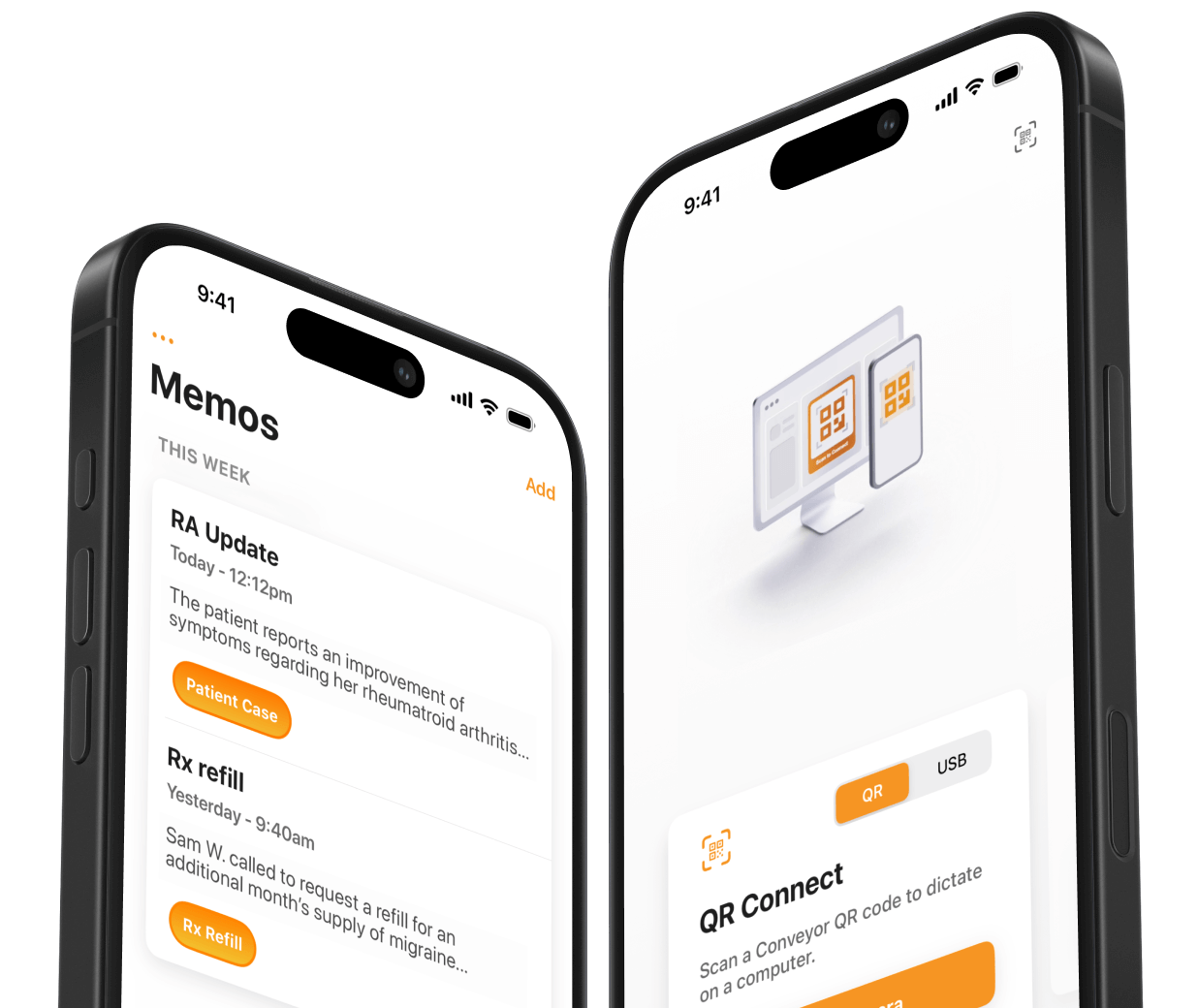
Clinical Documentation Built for Your Specialty
Every specialty documents care differently. A dermatology note looks very different from an emergency medicine chart, while psychiatry, surgery, primary care, and other specialties each have their own documentation needs.
Conveyor AI gives clinicians multiple ways to document, including ambient AI scribing, medical dictation, customizable templates, text macros, and other workflow tools designed to support specialty-specific documentation.
Capture patient conversations, dictate directly into your workflow, customize your notes, and transfer documentation into the EHR you already use.
Explore how Conveyor supports your specialty.





Concierge Medicine
Longer appointments often mean more detailed documentation. Conveyor AI helps capture the full story of each concierge visit, creating structured clinical notes that reflect complex discussions, preventive care, and personalized treatment plans while reducing time spent charting. AI Scribe for Concierge Medicine

Psychiatry
Psychiatric documentation depends on nuance, context, and detail. Conveyor AI helps organize patient conversations into structured psychiatric notes while preserving important clinical information and reducing time spent documenting after each visit.

Orthopedics
From fracture evaluations to post-operative follow-ups, orthopedic providers manage a wide range of encounters. Conveyor AI supports fast, structured orthopedic documentation for busy clinics and procedure-heavy workflows.

Pediatrics
Pediatric visits often involve parents, caregivers, developmental history, preventive care, and complex conversations. Conveyor AI helps create organized pediatric documentation that reflects the complete encounter while allowing clinicians to stay focused on patients and families.

Emergency Medicine
Emergency medicine demands fast, accurate documentation without slowing patient care. Conveyor AI helps clinicians capture encounters, create structured emergency department notes, and keep up with documentation during even the busiest shifts.
AI Scribe for Emergency Medicine

Internal Medicine
Internal medicine visits often involve multiple chronic conditions, medications, and complex medical decision-making. Conveyor AI helps organize detailed patient conversations into comprehensive clinical notes that reflect the full encounter.
Family Medicine & Primary Care
No two primary care visits are alike. From wellness exams and chronic disease management to acute illness, Conveyor AI helps create organized documentation that adapts to a wide variety of patient encounters.

Diagnostic Radiology
Radiology reporting depends on accuracy, speed, and consistency. Conveyor AI supports radiologists with medical dictation and AI-powered documentation tools that help create clear, structured reports while maintaining an efficient workflow.

Dermatology
Dermatology clinics move quickly, with high patient volumes and documentation that depends on precise clinical descriptions. Conveyor AI helps create detailed dermatology notes that capture findings, procedures, and treatment plans while helping providers stay on schedule.
Behavioral Health
Behavioral health visits require thoughtful, detailed documentation. Conveyor AI helps turn patient conversations into structured behavioral health notes, allowing clinicians to stay engaged during the session while reducing documentation time afterward.
Works with your EHR and your workflow
Conveyor AI works alongside Epic, athenahealth, eClinicalWorks, ModMed, Practice Fusion, and all other EMRs, giving you the flexibility to document the way you prefer. Capture patient conversations, dictate anywhere in your workflow, customize your notes, and move documentation into the EHR you already use.
Frequently Asked Questions
Find answers about how Conveyor AI works with your EHR, supports specialty-specific documentation, protects patient information, and fits into your clinical workflow.
Does Conveyor AI work for my specialty?
Yes. Conveyor AI supports a wide range of medical specialties and can adapt note structure, terminology, and documentation workflows to fit both your specialty and how you practice. Don't see your specialty listed? Request a demo to see how it works with your practice.
How does Mobius handle specialty-specific terminology?
Healthcare demands special consideration when it comes to the language used in charting and documentation. Not only do medical professionals use words and phrases that are absent from colloquial conversation, but individual healthcare specialties often have their own lexicons as well. Mobius is trained to account for these differences when transcribing speech for dictation or listening to patient encounters for ambient scribe purposes. This training encompasses medical terminology, grammar, abbreviations and initialisms, sentence cadence and structure, as well as individual clinician preferences and vocabulary that may be hyperlocal or specific to a particular clinic.
Can I use my own templates?
Yes. Conveyor AI supports customizable note templates so you can create documentation that matches your preferred style and workflow.
What if my specialty isn't listed?
The specialties listed above represent some of our most common use cases, but Conveyor AI supports many others as well. If you don’t see your specialty listed, request a demo and we’ll walk through your documentation needs and show you how Conveyor can fit your workflow.
How accurate is Conveyor AI?
Conveyor AI uses advanced speech recognition and AI-powered documentation to create high-quality clinical notes from patient encounters. Every note can be reviewed and edited before it is added to the medical record, giving providers full control over the final documentation.
Which EHRs does Conveyor AI work with?
Conveyor AI works with virtually any EHR, including Epic, athenahealth, eClinicalWorks, ModMed, Practice Fusion, and many others. It fits into your existing workflow, so you can use AI scribing, medical dictation, and other documentation tools without changing the EHR you already use.

Ready to Focus on the Fix, Not the Form?
Stop letting documentation control your patient throughput and your work-life balance.

See Mobius in Your Specialty
See how Conveyor AI fits the way you document.
Request a demo and start a free trial for your specialty.